

Xient Resilience Intelligence · Strategic industry partners wanted
Sovereign Agentic GeoAI for clarity in critical situations.
Europe has satellites, sensors, drones, geospatial data, AI and high-performance computing. What is often missing in critical situations is the sovereign intelligence layer that turns all of it into decisions you can act on. That is exactly the layer we are building - as a new deep-tech strand for crisis intelligence, critical infrastructure and European resilience.
For this we are looking for selected strategic industry partners. Not as buyers, but as co-investors, co-development partners and early anchor partners.
The starting point
The data is there. The translation into decisions is not.
Crises are becoming more frequent, more complex and more data-rich - extreme weather, floods, wildfires, disruptions to critical infrastructure, hybrid threats. At the same time, never before has so much situational information been available: Copernicus provides European Earth observation, Galileo and EGNSS trusted positioning, drones local verification, sensors capture water levels, weather and infrastructure. Emergency teams, utilities and public authorities hold geospatial data, situation reports and operational systems.
What is often missing is the decisive layer in between: a sovereign intelligence layer that translates scattered data into traceable, accountable and actionable situational intelligence. This is exactly where Xient Resilience Intelligence comes in.
To that end, Xient is developing a sovereign Agentic GeoAI platform designed to turn satellite, EGNSS, drone, sensor, geospatial, infrastructure and situation-report data into an auditable decision layer - a technology that understands data sources, prepares analysis paths, makes uncertainty visible, detects contradictions, supports human decisions and documents critical steps in a traceable way.
The category
Crisis intelligence, not a crisis dashboard.
In critical situations, it is not the volume of available data that decides, but whether orientation emerges from it in time. A crisis team does not ask for raw data. A utility does not ask for isolated satellite images. A situation centre does not ask for yet another interface. The real questions are different:
- What is happening right now?
- Where is it happening?
- Which assets are affected?
- Which data confirms the situation?
- What information is missing?
- Which risks are rising?
- What is the next plausible measure?
- Which decision can a human take responsibility for?
Xient Resilience Intelligence is designed to address exactly these questions technically - not just displaying data sources side by side, but relating them: recognising which source is relevant in a given situation, where signals confirm or contradict one another, where uncertainty remains and when a human must be brought in.
The technology core
Five capabilities, one modular deep-tech stack.
Xient Resilience Intelligence is intended to emerge as a modular stack for Agentic GeoAI. At its core are five capabilities that together turn data into robust, accountable decision support.
Multi-Source Data Fusion
Satellite, EGNSS, drone, sensor, geospatial, asset and situation-report data are merged spatially, temporally and semantically - into a consistent situational picture that does not depend on any single source.
Agentic Workflow Orchestration
AI agents translate operational questions into technical analysis paths: selecting relevant sources, launching the right workflows, prioritising information, proposing next steps.
Uncertainty & Provenance
Not just results, but how robust they are: Where does the data come from? Which steps were taken? What evidence supports an assessment - and where does uncertainty remain?
Human-in-the-Loop Governance
Not a blindly automated decision system. Critical decisions stay human. The technology prepares, explains, prioritises and documents - it does not replace responsibility.
Sovereign Deployment & Validation
Geared towards sovereign, secure and auditable operating models. For validation, scaling and robustness testing we use European high-performance computing - Xient has concrete access to LUMI/EuroHPC.
The origin
From the European AEGIS concept to industrial maturity.
The conceptual origin lies in the European AEGIS concept from the Horizon Europe environment. AEGIS is framed as "Agentic European Intelligence for Crisis Management & Security" and designed over 36 months to combine Copernicus Earth observation, EGNSS, drone-based verification and local data into an agentic, human-supervised decision layer for crisis management.
Xient Resilience Intelligence carries this line forward - more focused, more industry-oriented and with the goal of developing a market-ready technology stack from the European research and concept core. AEGIS is thus the European origin and sister project; Xient Resilience Intelligence is Xient's own market-maturity strand. The question is no longer what a European crisis-intelligence system could look like, but how this technology reaches real industrial, infrastructural and public applications - together with the right partners.
More on the AEGIS research project →Why Xient
Deep tech with market-maturity discipline.
In sensitive, regulated environments, a good AI demo is not enough. What counts there is data sovereignty, role and access concepts, traceability, integration capability, operational security, auditability and acceptance among people who decide under pressure. We know this world from practice - from years in complex data, transformation and decision environments across industry, utilities, life sciences and large corporate structures.
Xient works at exactly the intersection where Xient Resilience Intelligence emerges: strategy, data, AI, governance, security and operational delivery. We bring together technical depth, delivery capability, governance thinking and a European sovereignty orientation - and the ability to translate research into market-ready solutions. This is therefore not research romanticism, but deep tech with market-maturity discipline.
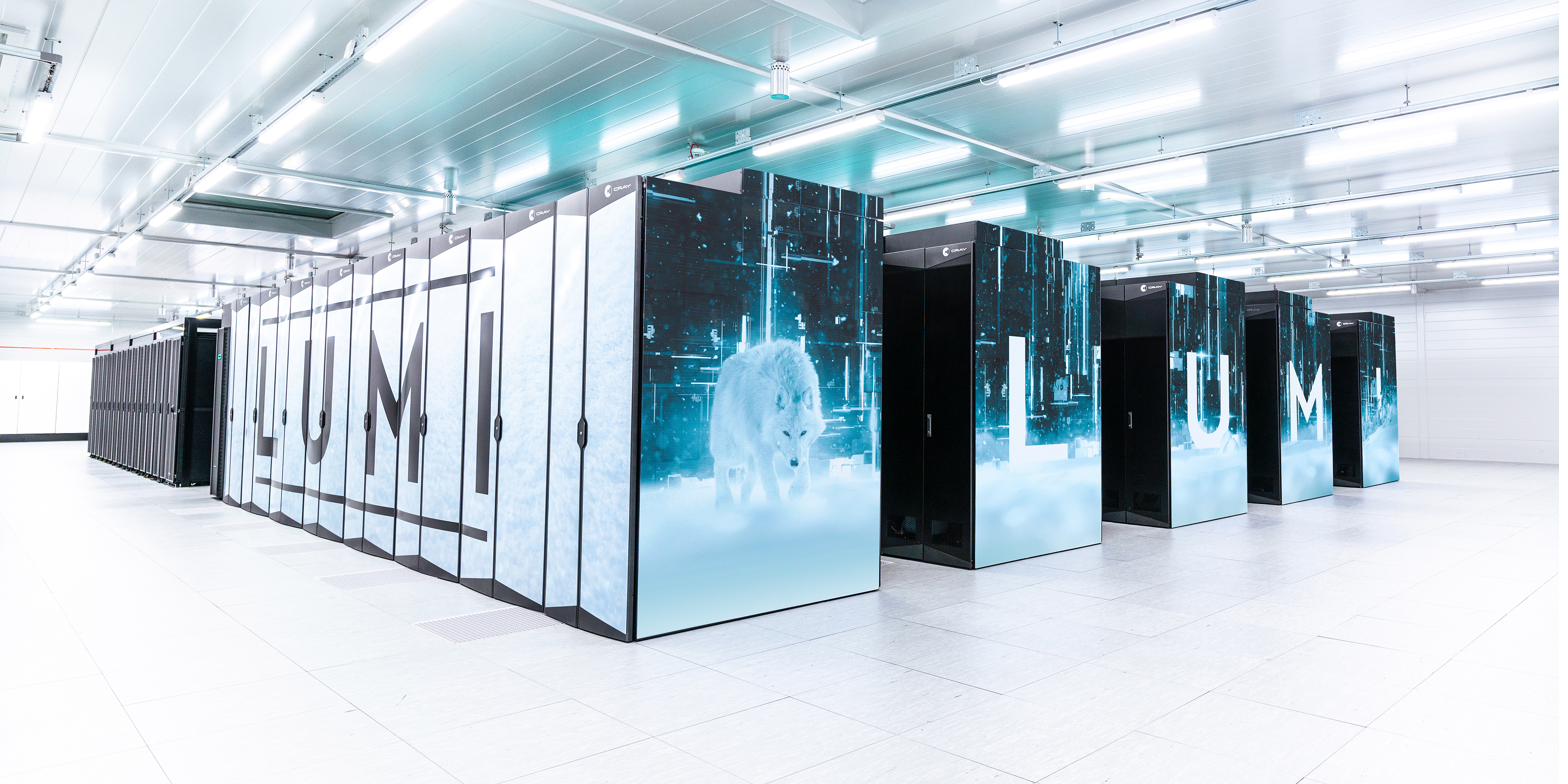
Sovereign computing infrastructure. Our existing assets include concrete access to European high-performance computing - LUMI/EuroHPC. For a company of our size this is a rare foundation: validation, scaling and robustness testing can take place on sovereign European infrastructure rather than on non-European platforms.
Scientific core. For the decisive phase, the involvement of a highly distinguished professor and institute director from the environment of Forschungszentrum Jülich is planned - bringing scientific depth, an academic network and experience in high-performance computing, AI and complex data spaces. The aim is not a superficial AI product, but a robust stack with methodological rigour and a scientific core.
From the Cologne region. The development is deliberately anchored here - central in Europe, close to Jülich, Bonn, Düsseldorf and Aachen, easily reached from Brussels. A potential hub between research, industry and European technology policy.
Where the technology works
Same foundation, concrete value per sector.
The technological base stays the same - the value becomes concrete for each sector. A strategic partner can shape a field early and secure preferential rights for it.
Water utilities
Heavy rainfall, water levels, flood risks, asset locations, network sections, access routes and deployment planning in one situational picture - instead of in separate systems.
Energy utilities
Weather events, grid infrastructure, substations, lines, disruptions, asset risks and external threat situations brought together and assessed.
Transport, ports & logistics
Accessibility, operational disruptions, weather, geospatial data, asset status and operational priorities as one shared situational-intelligence layer.
Public sector & crisis teams
As an additional intelligence layer on top of existing GIS, weather, sensor and situation systems. Compatible rather than replacing - with verifiable recommendations.
Defence-adjacent & security
Sovereign situational intelligence, data fusion, explainable analysis and human control. Explicitly not an autonomous decision or weapons system.
Space & Earth Observation
Bringing Earth observation from the expert context into operational use: translating human questions into EO workflows, combining them with local data, making uncertainty visible - answers instead of raw data.
The build-up
Start 2027. Preparation from now. Recruiting from September 2026.
Xient Resilience Intelligence is planned as a multi-year deep-tech build-up. Xient is not starting from zero: entrepreneurial leadership, the technological framework, AI and data expertise, European project experience and concrete access to European high-performance computing are in place. The team build-up is not about capability, but about strategic focus - a dedicated team, without breaking off ongoing client projects.
Laying the foundation
Technology core, funding logic, partner outreach, brand positioning and scientific anchoring are being prepared in parallel.
Building the core team
Targeted search for scientific and technical roles: GeoAI, remote sensing, agentic AI, HPC, data fusion, MLOps, security, provenance, validation.
Into delivery
Operational start of the market-maturity strand - prepared, staffed, scientifically anchored and with strategic partners.
A dual anchoring by design: one foot in deep tech, the other in the reality of demanding client projects.
Why now
Several developments are converging.
The timing is right because several lines are coming together:
- Crisis and resilience topics are becoming more strategic for the public sector, industry and infrastructure operators.
- The requirements for sovereign, controllable AI are rising.
- European space and computing infrastructures exist, but are still too rarely translated into operational applications.
- Agentic AI enables new forms of workflow orchestration.
- Pressure is growing not to outsource critical decision processes to black-box systems or non-European platform logic.
Europe needs systems that are not only intelligent, but trustworthy. Not only powerful, but sovereign. Not only automated, but controllable. The planned start from 2027 is deliberate: prepared, staffed, scientifically anchored and brought to market maturity with strategic partners - not rushed out of an opportunity.
For strategic industry partners
Those who come early can shape what emerges.
We are not looking for sales partners at the end of development, but for partners who join early, help shape the work and gain strategic access to an emerging technology stack. The basic idea is simple: whoever helps finance and shape the technology early should later not be treated like an ordinary customer.
This is not about blanket exclusivity across the whole platform, but about clearly defined models - by sector, use case, region, module, term and contribution. These roles can be combined:
Strategic Co-Investor
Finances part of the technology build-up and receives defined information, first-look, option or commercialization rights.
Industry Module Partner
Co-finances a sector-specific module and receives preferential rights in that segment.
Pilot & Validation Partner
Contributes real use cases, data realities and test environments and gains early access to results.
Technology Integration Partner
Integrates components into its own platforms, products or customer solutions - up to white-label and OEM paths.
Commercialization Partner
Brings sales, public-procurement experience or international scaling.
Strategic Anchor Partner
Combines several roles: co-investment, co-development, piloting, market access and later joint commercialization.
Depending on contribution and agreement, options can arise for early technology access, first look, co-development, pilot access, integration rights and time- or scope-limited sector rights for defined application fields.
What a partner can contribute. A partner does not have to finance everything - the forms of contribution can be combined:
- Finance part of the development
- Provide data, use cases or pilot environments
- Contribute sector knowledge and requirements
- Open access to customers, procurement paths or markets
- Contribute technical integration work
- Co-finance a sector module
- Act as an anchor reference
- Take on later commercialization or OEM integration
Why join early. Those who come late can buy what is finished. Those who come early can shape what emerges. An early partner brings in requirements before architecture decisions are settled, ensures the platform understands its sector, prioritises its own use cases, helps design pilot and integration paths, secures first look and, where applicable, sector options - and prevents a competitor from gaining the same access first.
This is particularly interesting for large industrial companies: they have market access, customer trust and sector knowledge, but not always the speed, focus or freedom to build such a deep-tech core internally from scratch. Xient thus offers a path between classic procurement and later M&A: early access, limited entry, co-shaping, strategic options.
Conceivable joint product lines
- Resilience Intelligence for Utilities
- Sovereign GeoAI for Critical Infrastructure
- Space-enabled Crisis Intelligence
- GeoAI Decision Support for Public Safety
- Infrastructure Risk Intelligence
- Resilience Cockpit for Industrial Sites
Particularly relevant for
- Space & Earth Observation
- Aerospace
- Defence-adjacent & security
- Critical infrastructure
- Energy
- Water
- Grids & transport
- Ports & airports
- Industry & site resilience
- GovTech & public safety
- Insurance & reinsurance
- IT integration & sovereign AI
Your contact
These partnerships are a matter for the top.
The next technology leap does not lie in even more data, but in the ability to translate data into robust decisions. If you want to shape crisis intelligence, GeoAI or European resilience rather than just observe it, let's talk.

Or write to us: via the contact form · +49 221 16533980
Xient Resilience Intelligence is under development. This initiative serves to approach selected strategic partners for co-development, piloting, technology integration and joint commercialization. It does not constitute a public offering of securities or capital investments. Partnership, investment, exclusivity or commercialization arrangements are agreed exclusively on an individual and confidential basis and subject to legal review.